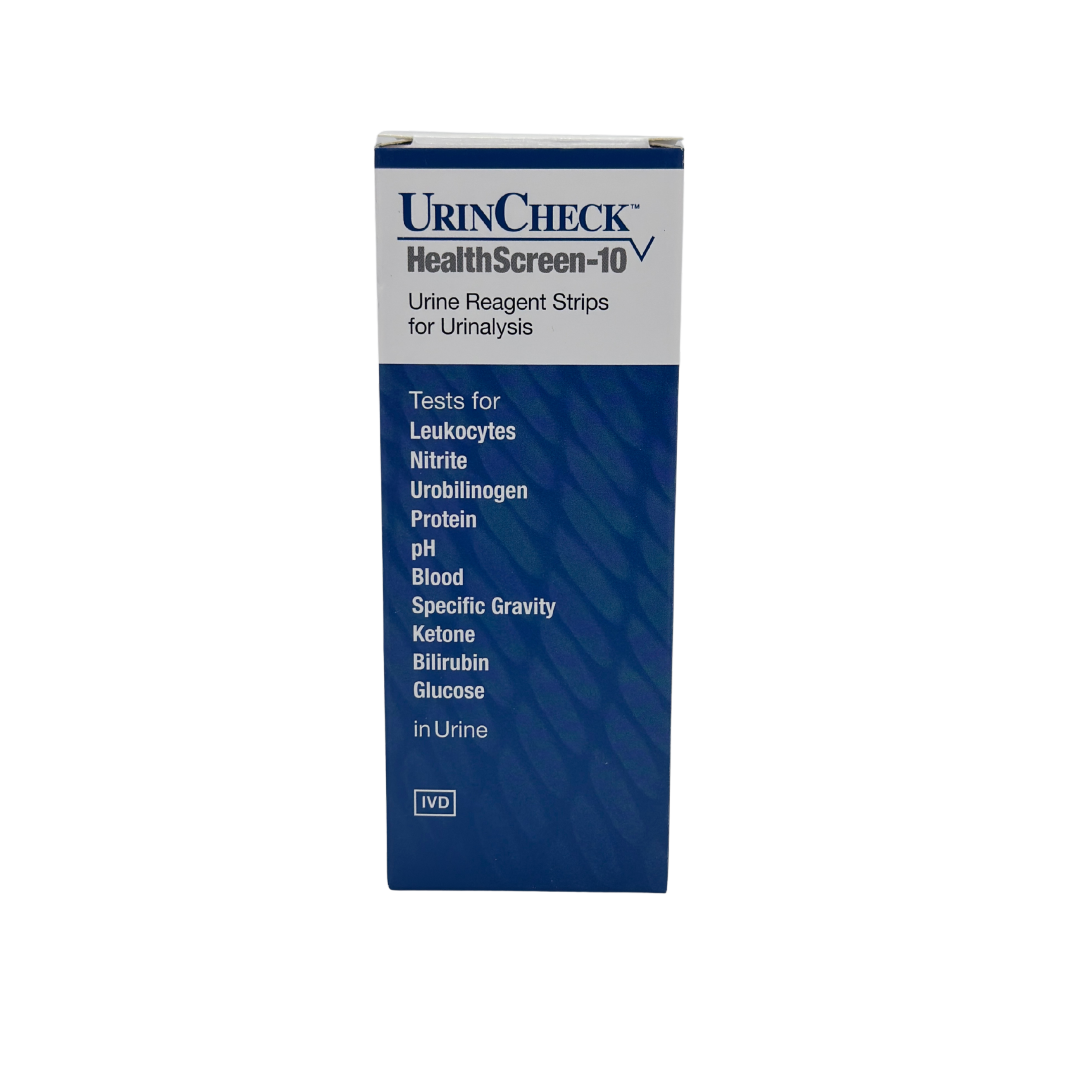
UrinCheck HealthScreen-10
UrinCheck HealthScreen-10
excl GST
Couldn't load pickup availability
UrinCheck™ HealthScreen-10 Urine Reagent Strips
1 box of 100 Semi-quantitative urinalysis reagent strips for rapid, visual detection of 10 health parameters in urine. Screens for Glucose, Bilirubin, Ketone, Specific Gravity, Blood, pH, Protein, Urobilinogen, Nitrite and Leukocytes — providing information on carbohydrate metabolism, kidney and liver function, acid-base balance and bacteriuria at the point of care.
Parameters Tested
Glucose / Bilirubin / Ketone
Specific Gravity / Blood / pH
Protein / Urobilinogen
Nitrite / Leukocytes
Comprehensive Urinalysis
A single reagent strip covers metabolic, renal, hepatic and infection markers — enabling a broad health screen without laboratory instruments. Results are obtained by direct colour comparison with the chart printed on the bottle label.
Best For
General practice clinics, emergency departments, pre-employment and workplace health screening, aged care facilities, rehabilitation centres, pathology collection centres and point-of-care testing programs.
Test Parameters & Clinical Significance
| Parameter | Read Time | Detection Range | Clinical Significance |
|---|---|---|---|
| Glucose | 30 sec | ≥ 100 mg/dL | Carbohydrate metabolism / diabetes screening |
| Bilirubin | 30 sec | 0.4–0.8 mg/dL | Liver function / hepatobiliary disorders |
| Ketone | 30 sec | ≥ 5 mg/dL | Ketoacidosis / fasting / metabolic status |
| Specific Gravity | 30 sec | 1.000–1.030 | Hydration status / renal concentrating ability |
| Blood | 30 sec | ≥ 0.015 mg/dL Hb | Haematuria / urinary tract or kidney disorders |
| pH | 30 sec | 5.0–9.0 | Acid-base balance / urinary tract infections |
| Protein | 30 sec | ≥ 15 mg/dL | Kidney function / proteinuria screening |
| Urobilinogen | 30 sec | ≥ 0.2 EU/dL | Liver function / haemolytic conditions |
| Nitrite | 30 sec | ≥ 0.075 mg/dL | Urinary tract infection (Gram-negative bacteria) |
| Leukocytes | 2 min | Trace–Large | Urinary tract infection / inflammation |
Expected Normal Values
| Parameter | Normal Result | Follow-Up Indicated |
|---|---|---|
| Glucose | Negative | Any colour match ≥ Trace |
| Bilirubin | Negative | Any atypical colour warrants investigation |
| Ketone | Negative | Positive may occur with fasting or stress |
| Specific Gravity | 1.003–1.040+ | Fixed at 1.010 suggests renal damage |
| Blood | Negative | Green spots or colour change — investigate |
| pH | 5.0–7.0 (avg 6.0) | Newborn 5.0–7.0; values outside range |
| Protein | Negative / Trace | Any colour block > Trace indicates proteinuria |
| Urobilinogen | 0.2–1.0 EU/dL | ≥ 2.0 EU/dL is clinically significant |
| Nitrite | Negative | Any pink colour suggests bacterial infection |
| Leukocytes | Negative | Trace result — repeat with fresh sample |
As with all laboratory tests, definitive diagnostic or therapeutic decisions should not be based on any single test result or method.
How to Use
- Collect urine in a clean container and test as soon as possible. Do not centrifuge. If testing cannot be performed within one hour after voiding, refrigerate the specimen immediately and allow it to return to room temperature before testing.
- Remove from the bottle only enough strips for immediate use and replace the cap tightly.
- Completely immerse all reagent areas of the strip in fresh, well-mixed urine. Remove the strip immediately to avoid dissolving out the reagent areas.
- While removing, touch the side of the strip against the rim of the urine container to remove excess urine. Blot the lengthwise edge on absorbent paper towel to further remove excess urine and avoid running over (contamination from adjacent reagent pads).
- Compare each reagent area to its corresponding colour block on the bottle label and read at the times specified. Proper read time is critical for optimal results.
- Obtain results by direct colour chart comparison.
How to Interpret Results
- Negative: The reagent area colour matches the "Negative" block on the bottle label colour chart for that parameter.
- Positive / Abnormal: The reagent area colour matches a block beyond "Negative" on the colour chart. The intensity of the colour change corresponds to the concentration — compare carefully at the specified read time.
- Semi-Quantitative: For Glucose, Ketone, Specific Gravity, Blood, Protein, Urobilinogen and pH, the colour chart provides graded values allowing estimation of concentration.
What's Included
- UrinCheck™ HealthScreen-10 Urine Reagent Strips x100
- Desiccant (built into bottle cap — do not remove)
- Package Insert / Instructions for Use
- Colour comparison chart printed on bottle label
Specimen collection container and timer are required but not included.
Parameter Details
Metabolic Parameters:
- Glucose — Based on a glucose oxidase / peroxidase enzyme reaction. Specific for glucose; no other substances excreted in urine give a positive result. Detects approximately 100 mg/dL glucose in urine.
- Ketone — Reacts with acetoacetic acid in urine via sodium nitroprusside. Detects as little as 5–10 mg/dL acetoacetic acid. May be positive during fasting, pregnancy, frequent strenuous exercise, or abnormal carbohydrate metabolism.
- pH — Double indicator method (bromothymol blue and methyl red) providing differentiation across pH 5–9. Normal adult average 6.0; newborn 5.0–7.0.
- Specific Gravity — Based on apparent pKa change of pretreated polyelectrolytes in relation to ionic concentration. Measures between 1.000 and 1.030. Normal adults: 1.003–1.040+.
Liver & Kidney Parameters:
- Bilirubin — Based on the coupling of bilirubin with diazotized dichloroaniline. Sensitivity of 0.4–0.8 mg/dL. Normally not detectable — any positive result warrants further investigation.
- Protein — Based on the protein error-of-indicator principle. More sensitive to albumin than globulin; sensitive to approximately 15 mg/dL albumin. Normal excretion is 1–14 mg/dL.
- Urobilinogen — Modified Ehrlich reaction. Normal range 0.2–1.0 EU/dL. Values ≥ 2.0 EU/dL may be clinically significant.
Infection & Haematuria Parameters:
- Nitrite — Detects conversion of nitrate to nitrite by Gram-negative bacteria. Any degree of pink colouration is suggestive of ≥ 10⁵ or more organisms/mL. Bladder incubation of ≥ 4 hours recommended for optimal sensitivity.
- Leukocytes — Based on the action of esterase present in leukocytes. Positive results indicate possible urinary tract infection or inflammation. Read at 2 minutes.
- Blood — Based on pseudoperoxidase action of haemoglobin and erythrocytes. Sensitivity to free haemoglobin of 0.015 mg/dL or 5–10 intact red blood cells/µL. Green spots or green colour developing within 30 seconds is significant.
Storage & Shelf Life
- Store at room temperature between 15–30°C (59–86°F) and out of direct sunlight.
- Stable through the expiration date printed on the bottle label.
- Do not use after the expiration date.
- All unused strips must remain in the original bottle. Do not remove desiccant from bottle.
- Opened bottles should be used within 3 months after first opening.
Product Specifications
- Test: UrinCheck™ HealthScreen-10 Urine Reagent Strips
- Format: Plastic reagent strip with 10 colour-change pads
- Parameters: Glucose / Bilirubin / Ketone / Specific Gravity / Blood / pH / Protein / Urobilinogen / Nitrite / Leukocytes
- Read Time: 30 seconds (Leukocytes at 2 minutes). Do not read after 2 minutes.
- Sample: Fresh, well-mixed urine
- Method: Visual colour comparison — no instrument required
- Use: For healthcare professionals including professionals at point of care sites. In vitro diagnostic use only.
- Manufacturer: CareHealth America Corporation, Irwindale, CA, U.S.A.
FAQ
What is the HealthScreen-10 used for?
It is a comprehensive urinalysis reagent strip designed for rapid, point-of-care screening of 10 health parameters. It provides information regarding carbohydrate metabolism, kidney and liver function, acid-base balance, and the presence of urinary tract infection — without the need for laboratory instruments.
How quickly can I read the results?
Most parameters are read at 30 seconds after dipping. Leukocytes should be read at 2 minutes. For semi-quantitative results (e.g. Glucose at 10 or 30 seconds), refer to the colour chart timing instructions on the bottle label. Do not interpret results after 2 minutes as colour changes beyond this point have no diagnostic value.
Can medications or diet affect the results?
Yes. For example, large doses of chlorpromazine or rifampen may interfere with the Bilirubin reading. Ascorbic acid (vitamin C) at ≥ 25 mg/dL may cause false negatives on the Glucose and Bilirubin pads. Highly buffered alkaline urine may cause elevated Specific Gravity readings, and medications such as L-dopa metabolites may affect the Ketone pad. Always correlate results with clinical presentation.
Does a positive Nitrite result confirm a urinary tract infection?
A positive Nitrite result is suggestive of significant bacteriuria (≥ 10⁵ organisms/mL) caused by Gram-negative bacteria that convert nitrate to nitrite. However, a negative result does not rule out infection — some organisms do not produce nitrite, and short bladder incubation times reduce sensitivity. Combine Nitrite and Leukocyte results for a more complete assessment, and confirm with culture where indicated.
Why is proper read timing important?
Each reagent pad is formulated to produce an accurate colour at a specific time. Reading too early may miss a developing reaction, while reading too late can cause colour drift that does not correlate with the actual concentration. Always use a timer and read at the intervals specified on the bottle label.
Full Description
Full Description
Specification
Specification